Elon Musk Becomes the World’s First Trillionaire: The Strategies Behind a Historic $1 Trillion Fortune
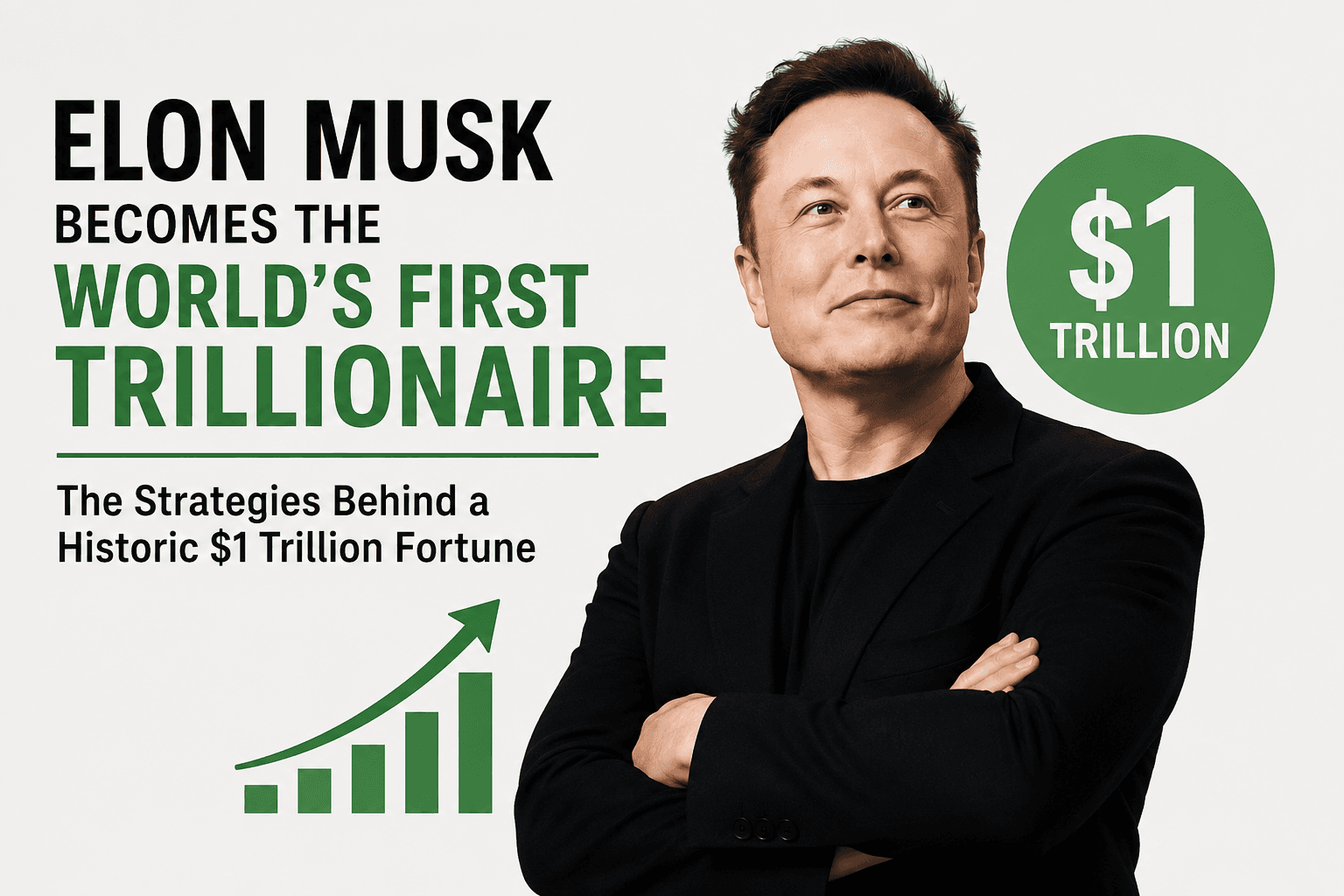
Elon Musk becomes the world's first trillionaire. Discover the strategies, companies, and vision that helped build a historic $1 trillion fortune.
Elon Musk Becomes the World’s First Trillionaire: The Strategies, Companies, and Vision Behind a Historic Milestone
Introduction
In June 2026, tech entrepreneur and investor Elon Musk officially became the world's first trillionaire after the highly anticipated IPO of SpaceX pushed his net worth beyond the $1 trillion mark. According to multiple financial reports, Musk's fortune surged past $1 trillion as SpaceX's valuation exploded after its public market debut. ([Business Insider][1])
For decades, becoming a trillionaire seemed impossible. Even the wealthiest people in history never came close to such a number. Yet Musk achieved what many economists, investors, and business leaders once considered unimaginable.
But this story is bigger than one man becoming extraordinarily wealthy.
The real question is:
How did Elon Musk build a trillion-dollar fortune?
And perhaps even more importantly:
What business strategies allowed him to create multiple billionaire founders, executives, and investors along the way?
From Billionaire to Trillionaire
Before the SpaceX IPO, Musk was already the richest person on Earth thanks to his holdings in SpaceX, Tesla, xAI, Neuralink, and The Boring Company.
The major catalyst that pushed him beyond $1 trillion was SpaceX's stock market debut, which valued the company at roughly $2 trillion. Musk's ownership stake in SpaceX became worth hundreds of billions of dollars on paper, pushing his total fortune above the trillion-dollar threshold. ([Business Insider][1])
While critics point out that most of this wealth exists in company shares rather than cash, the achievement remains historic.
The Secret Strategy: Owning Massive Stakes
One of Musk's biggest wealth-building principles is surprisingly simple:
Own the company.
Most executives receive salaries.
Musk focused on owning large percentages of businesses that could dominate entire industries.
Instead of earning income primarily through wages, he accumulated equity.
When those companies grew, his ownership stake multiplied in value.
This strategy is common among the world's richest entrepreneurs:
- Jeff Bezos owned a major stake in Amazon.
- Mark Zuckerberg owns a large share of Meta.
- Larry Page benefited from Google's growth.
Musk simply applied the same principle on an even larger scale across several companies simultaneously.
SpaceX: The Biggest Wealth Creator
If Tesla made Musk famous, SpaceX made him a trillionaire.
When SpaceX launched in 2002, many experts believed a private space company would fail.
The company suffered multiple rocket explosions and nearly ran out of money.
Instead of giving up, Musk invested nearly everything he had left.
Today SpaceX dominates:
- Commercial satellite launches
- Government contracts
- Deep-space exploration projects
- Global satellite internet through Starlink
Investors increasingly view SpaceX not merely as a rocket company but as a future infrastructure company for Earth and space. This perception helped drive its enormous valuation. ([Business Insider][1])
Tesla: The Company That Changed Transportation
While SpaceX became the largest contributor to Musk's fortune, Tesla remains one of the greatest business success stories of the 21st century.
Years ago, electric vehicles were considered niche products.
Tesla transformed them into mainstream consumer products while simultaneously building:
- Battery technology
- Charging networks
- Energy storage systems
- Autonomous driving technology
Tesla's growth turned early employees, investors, and executives into millionaires—and in some cases, billionaires.
Many former Tesla employees used their experience and wealth to launch startups of their own.
This is one reason Silicon Valley investors often describe Tesla as a "talent factory."
How Musk's Companies Created Other Millionaires
One overlooked aspect of Musk's success is that his companies generated wealth for thousands of others.
Early Employees
Employees who received stock options at Tesla or SpaceX often saw those shares increase dramatically in value.
Many became millionaires.
Some used that wealth to:
- Start new businesses
- Become angel investors
- Fund technology startups
Startup Founders
Former Tesla and SpaceX employees have launched dozens of successful startups in:
- Artificial intelligence
- Robotics
- Aerospace
- Battery technology
- Clean energy
This created a ripple effect across the technology sector.
In many ways, Musk's companies became incubators for future entrepreneurs.
The Power of Solving Massive Problems
Another key lesson from Musk's journey:
Big wealth often follows big problems.
Each of Musk's major companies targets enormous industries:
| Company | Problem Being Solved |
|---|---|
| Tesla | Sustainable transportation |
| SpaceX | Affordable space access |
| Starlink | Global internet connectivity |
| Neuralink | Brain-machine communication |
| xAI | Artificial intelligence |
| The Boring Company | Urban transportation congestion |
Rather than building small businesses, Musk repeatedly targeted trillion-dollar markets.
This dramatically increased the upside potential.
Musk's Obsession With Long-Term Thinking
Many CEOs focus on quarterly profits.
Musk often focuses on decades.
Examples include:
- Colonizing Mars
- Global satellite internet
- Artificial intelligence
- Autonomous transportation
- Human-machine interfaces
Whether these goals ultimately succeed or fail, investors reward companies that appear positioned to shape the future.
This long-term vision helped drive investor enthusiasm across Musk's business empire.
Risk Taking: The Characteristic That Changed Everything
A common theme throughout Musk's career is extreme risk tolerance.
He famously invested much of his fortune into:
- Tesla
- SpaceX
At one point, both companies were reportedly close to failure.
Had either collapsed, Musk might have lost nearly everything.
Instead, he doubled down.
Most people avoid large risks.
Musk repeatedly embraced them.
That doesn't guarantee success, but it explains why the rewards became so enormous when the bets worked.
Why Investors Keep Betting on Musk
Even critics acknowledge one reality:
Musk has repeatedly built companies that many experts thought were impossible.
Examples include:
- Reusable rockets
- Mass-market electric vehicles
- Satellite internet networks
- Advanced AI systems
Because of this track record, investors often assign premium valuations to businesses associated with him.
The result is a powerful cycle:
- Investors trust Musk.
- Companies receive funding.
- Companies grow rapidly.
- Valuations increase.
- Musk's wealth grows.
Public Reactions Across Social Media
The trillionaire milestone triggered intense debate online.
Supporters celebrated it as proof that innovation and entrepreneurship can create extraordinary value.
Critics argued that no individual should possess such immense wealth and called for discussions about taxation and economic inequality. Reports from media outlets and online discussions showed strong reactions on both sides of the debate. ([Axios][2])
Some entrepreneurs praised Musk's persistence and willingness to pursue ambitious projects.
Others questioned whether modern financial markets are creating excessive concentrations of wealth.
Regardless of where people stand, the achievement has become one of the most discussed business stories of 2026.
Lessons Entrepreneurs Can Learn
1. Think Bigger
Musk consistently targeted industries worth trillions of dollars.
2. Focus on Ownership
Building equity can create more wealth than earning salary alone.
3. Take Calculated Risks
Major rewards often require significant risk.
4. Attract Great Talent
Successful companies are built by exceptional teams.
5. Stay Long-Term Focused
Some of Musk's biggest wins took decades to develop.
6. Solve Important Problems
The larger the problem, the larger the opportunity.
The Challenges Ahead
Becoming a trillionaire does not guarantee permanent success.
Musk's fortune remains heavily tied to stock valuations.
Future challenges include:
- Increased competition
- Regulatory scrutiny
- AI safety concerns
- Economic downturns
- Space industry risks
As history has shown, fortunes can rise and fall rapidly.
Still, Musk's place in business history is now secure.
Conclusion
Elon Musk's rise to becoming the world's first trillionaire is not merely a story about money.
It is a story about ownership, innovation, risk-taking, long-term thinking, and the ability to build companies that reshape industries.
Whether one views him as a visionary entrepreneur or a controversial billionaire, his influence on technology, transportation, artificial intelligence, and space exploration is undeniable.
Perhaps the most important takeaway isn't that Musk became a trillionaire.
It's that he built multiple companies that created wealth for thousands of employees, investors, founders, and innovators along the way.
That ripple effect may ultimately become a larger part of his legacy than the trillion-dollar number itself.
FAQs
Did Elon Musk really become the world's first trillionaire?
Yes. Following SpaceX's public market debut in June 2026, several major financial outlets reported that Musk's net worth exceeded $1 trillion based on the market value of his company holdings. ([Business Insider][1])
Is Elon Musk's trillion dollars cash?
No. Most of his wealth exists as ownership stakes in companies such as SpaceX and Tesla.
What company contributed most to Musk's trillionaire status?
SpaceX was the primary driver, with its IPO significantly increasing the value of Musk's holdings. ([Business Insider][1])
Did Musk create other millionaires?
Yes. Many Tesla and SpaceX employees received stock compensation that appreciated significantly, creating numerous millionaires and helping fund future startups.
What is Elon Musk's most important business strategy?
One of his key strategies has been maintaining significant ownership stakes in companies that address massive global challenges.
Could another trillionaire emerge soon?
It's possible. Entrepreneurs such as Mark Zuckerberg, Jeff Bezos, and Larry Page are often mentioned as potential future trillionaire candidates if their companies continue to grow rapidly.
Reader discussion
Join the conversation
Share your thoughts on this article. Comments are stored in MongoDB and appear instantly below.