Data Scientist Salary in Germany 2026: Career, Skills & Job Demand
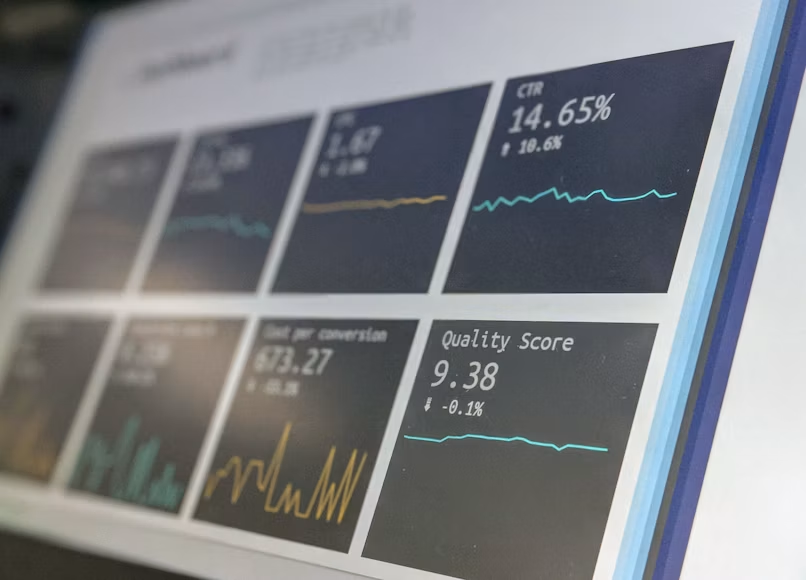
Explore Data Scientist salaries in Germany in 2026, including entry-level and senior pay, top-paying cities, job demand, required skills, career growth, education requirements, and EU Blue Card options for international professionals.
Introduction
Germany is one of Europe's strongest markets for technology, engineering, manufacturing, finance, and digital transformation. As companies collect larger amounts of data and adopt artificial intelligence, machine learning, automation, and cloud technologies, the role of Data Scientists is becoming increasingly important.
Data Scientists help businesses turn large datasets into useful insights and predictive models. They can work on everything from customer analytics and fraud detection to industrial automation, predictive maintenance, recommendation systems, and artificial intelligence.
For international professionals, Germany is also attractive because it has established immigration pathways for qualified workers, including the EU Blue Card.
But how much can a Data Scientist actually earn in Germany in 2026?
Salary depends heavily on experience, location, industry, technical specialization, company size, and qualifications. Current salary sources also report different figures because they use different datasets and definitions of the Data Scientist role.
This guide explains Data Scientist Salary in Germany 2026, including salaries by experience, highest-paying cities, job demand, required skills, career progression, education requirements, and immigration options for foreign professionals.
Data Scientist Salary in Germany 2026
There is no single salary that applies to every Data Scientist in Germany.
According to Stepstone's current Germany salary data, the median Data Scientist salary is approximately €57,200 gross per year, with reported salaries varying according to experience and location.
The German Federal Employment Agency's Entgeltatlas reports a €6,702 monthly median gross salary for Data Scientist roles classified within its relevant highly complex IT occupational category.
These figures demonstrate why salary research should always consider the source and job classification.
Estimated 2026 Salary Range
| Experience Level | Approx. Annual Gross Salary |
|---|---|
| Junior Data Scientist | €50,000 – €60,000 |
| Data Scientist | €55,000 – €70,000 |
| Mid-Level Data Scientist | €65,000 – €80,000 |
| Senior Data Scientist | €75,000 – €95,000+ |
| Lead Data Scientist | €90,000 – €110,000+ |
| Data Science Manager | €100,000 – €130,000+ |
| Specialized AI/ML Leadership | €120,000+ |
These are market estimates rather than guaranteed salaries. Actual offers can be lower or higher depending on the employer, location, specialization, and candidate profile.
Data Scientist Salary by Experience
Experience is one of the most important factors affecting salary.
Junior Data Scientist
A junior Data Scientist may earn approximately:
€50,000 – €60,000 per year
Junior professionals commonly work on:
- Data cleaning
- Data analysis
- SQL queries
- Visualization
- Basic machine-learning models
- Statistical analysis
- Reporting
- Supporting senior Data Scientists
A strong background in mathematics, statistics, computer science, engineering, or data science can help candidates enter this field.
Mid-Level Data Scientist
Professionals with several years of experience can potentially target:
€65,000 – €80,000+ annually
At this level, companies may expect professionals to independently handle:
- Machine-learning projects
- Feature engineering
- Model evaluation
- Statistical analysis
- Data pipelines
- Business analytics
- Experimentation
- Communication with stakeholders
Cloud and software-engineering knowledge can also increase a candidate's value.
Senior Data Scientist
Senior Data Scientists can potentially earn:
€75,000 – €95,000+ per year
Senior professionals may be responsible for:
- Leading data projects
- Designing machine-learning systems
- Mentoring junior employees
- Selecting algorithms
- Improving production models
- Communicating results to management
- Working with large-scale datasets
Professionals specializing in AI, machine learning, automotive technology, finance, or advanced analytics may command higher compensation.
Highest-Paying Data Science Specializations in Germany
Data Science is a broad field, and specialization can have a significant effect on earning potential.
1. Machine Learning Engineer
Machine Learning Engineers combine machine learning with software engineering.
Important skills include:
- Python
- PyTorch
- TensorFlow
- APIs
- Docker
- Kubernetes
- Cloud computing
- MLOps
This career is particularly valuable when companies need to move machine-learning models from development into production.
2. AI Engineer
AI Engineering is becoming increasingly important as companies adopt modern artificial intelligence.
AI professionals may work with:
- Large language models
- Generative AI
- Natural language processing
- Computer vision
- AI agents
- Recommendation systems
- Model evaluation
- AI security
Germany's ICT labor market is also being influenced by AI, automation, and digital transformation, which are increasing the importance of advanced technical skills.
3. Data Engineer
Data Engineers create the infrastructure used by Data Scientists.
They commonly work with:
- Data warehouses
- Data lakes
- ETL pipelines
- SQL
- Apache Spark
- Kafka
- Cloud platforms
- Databases
A Data Scientist who understands data engineering can work across more stages of the data lifecycle.
4. MLOps Engineer
MLOps combines:
Machine Learning + Software Engineering + DevOps
MLOps professionals help companies deploy, monitor, maintain, and scale machine-learning models.
Important skills include:
- Docker
- Kubernetes
- CI/CD
- Cloud platforms
- Model monitoring
- Git
- Python
- Infrastructure as Code
This can be an excellent specialization for professionals who enjoy both machine learning and software infrastructure.
5. Quantitative Data Scientist
Financial institutions use advanced data science for:
- Fraud detection
- Risk management
- Credit scoring
- Financial forecasting
- Portfolio analysis
- Trading
Professionals with strong mathematics, statistics, and programming skills can find opportunities in Germany's financial sector.
Best German Cities for Data Scientists
Location can significantly affect both salary and living expenses.
Current Stepstone data lists several German cities with strong reported Data Scientist salaries.
| City | Approx. Reported Salary |
|---|---|
| Stuttgart | €64,300 |
| Hamburg | €60,400 |
| Berlin | €59,400 |
| Düsseldorf | €59,100 |
| Bremen | €58,500 |
| Leipzig | €58,000 |
| Dresden | €57,900 |
| Duisburg | €57,800 |
These figures are reported market data rather than guaranteed salaries.
Munich
Munich is one of Germany's strongest technology and corporate markets.
Major sectors include:
- Automotive
- Insurance
- Banking
- Software
- AI
- Industrial technology
The major disadvantage is the high cost of housing.
Berlin
Berlin has a large technology and startup ecosystem.
Data professionals can find opportunities in:
- Fintech
- SaaS
- AI
- E-commerce
- Digital platforms
Stuttgart
Stuttgart is particularly important for:
- Automotive
- Manufacturing
- Engineering
- Industrial AI
- Robotics
The city also has strong demand for professionals who can combine data science with engineering.
Hamburg
Hamburg has opportunities in:
- Logistics
- Aviation
- E-commerce
- Finance
- Technology
Data Scientist Job Demand in Germany in 2026
Germany continues to have a large technology sector, although the labor market is not equally strong across every technology occupation.
The German Federal Employment Agency reported that the ICT labor market remains dynamic, while economic conditions have affected recruitment momentum. At the same time, digitalization, automation, and AI are increasing the technical skills required by employers.
For Data Scientists, opportunities can be found in:
- Automotive
- Manufacturing
- Banking
- Insurance
- Healthcare
- Logistics
- Retail
- Telecommunications
- Energy
- Software
- Consulting
The strongest candidates are often those who can connect data science with practical business problems.
Why Germany Needs Data Scientists
Germany's economy has a particularly strong manufacturing and engineering base.
Data Science is increasingly used for industrial and business applications.
Predictive Maintenance
Machine-learning systems can analyze equipment data and identify potential failures before they happen.
Manufacturing Optimization
Companies can use data to improve:
- Production efficiency
- Quality control
- Supply chains
- Inventory
- Energy consumption
Autonomous Systems
Data science and machine learning contribute to:
- Robotics
- Autonomous vehicles
- Industrial automation
- Computer vision
Financial Risk
Banks and financial companies use analytics for:
- Fraud detection
- Credit risk
- Customer behavior
- Financial forecasting
Healthcare
Data science can support:
- Medical research
- Diagnostics
- Patient analytics
- Drug development
- Healthcare operations
Skills Required for Data Scientists in Germany
A successful Data Scientist needs more than machine-learning knowledge.
Employers often look for a combination of programming, statistics, data engineering, machine learning, and business understanding.
Programming
The most important programming language is generally:
Python
You should also understand:
- SQL
- R
- Git
- APIs
- Basic software engineering
Statistics and Mathematics
Important topics include:
- Probability
- Statistics
- Regression
- Hypothesis testing
- Linear algebra
- Optimization
- Experimental design
Strong fundamentals help professionals understand whether a model is actually reliable.
Machine Learning
Important areas include:
- Supervised learning
- Unsupervised learning
- Classification
- Regression
- Clustering
- Neural networks
- Feature engineering
- Model evaluation
- Hyperparameter optimization
Popular tools include:
- Scikit-learn
- PyTorch
- TensorFlow
SQL and Databases
SQL remains one of the most important practical skills.
Data Scientists should understand:
- SELECT
- JOIN
- GROUP BY
- Window functions
- Subqueries
- CTEs
- Database optimization
A candidate who can efficiently work with real-world datasets is generally more useful than someone who understands machine-learning theory but cannot retrieve or manipulate data effectively.
Cloud Computing
Cloud skills can improve your career opportunities.
Popular platforms include:
- AWS
- Microsoft Azure
- Google Cloud
Useful cloud knowledge includes:
- Cloud storage
- Compute
- Databases
- IAM
- Containers
- Machine-learning services
Generative AI Skills
Generative AI has become an important technology area in 2026.
Data Scientists can benefit from understanding:
- Large language models
- Retrieval-augmented generation
- Embeddings
- Vector databases
- AI evaluation
- Prompt engineering
- AI agents
- Model monitoring
However, simply knowing how to use AI tools is not enough.
Employers increasingly need professionals who understand how AI systems work and how to integrate them into reliable applications.
Is German Language Required for Data Scientist Jobs?
German language requirements depend on the employer.
International technology companies may operate primarily in English, particularly in major technology hubs.
However, German language skills can expand your opportunities.
German can be particularly useful when working with:
- Traditional German companies
- Government organizations
- Local clients
- Manufacturing companies
- Healthcare
- Consulting
- Customer-facing teams
Useful Language Levels
English: Professional working proficiency
German: A2–B1 can help with daily life, while B2 or higher can expand professional opportunities.
Not every job requires German, so candidates should always check the language requirements in individual job advertisements.
Education Requirements for Data Scientists in Germany
Many Data Scientist positions expect a strong academic background.
Common degrees include:
- Computer Science
- Data Science
- Statistics
- Mathematics
- Artificial Intelligence
- Engineering
- Physics
- Economics
- Business Analytics
A master's degree can be particularly useful for research-heavy positions.
However, employers may also evaluate:
- Work experience
- Portfolio projects
- Programming skills
- Machine-learning knowledge
- Industry experience
- Communication skills
Can You Become a Data Scientist Without a Degree?
It is possible to enter some data-related positions without a traditional university degree, but Data Scientist positions in Germany often have relatively high educational expectations.
Without a degree, an alternative route could be:
Data Analyst → Junior Data Scientist → Data Scientist
Another route is:
Software Developer → Machine Learning Engineer → Data Scientist
A strong portfolio can help demonstrate practical ability.
Build projects involving:
- Python
- SQL
- Machine learning
- Data visualization
- APIs
- Real datasets
- Cloud deployment
Best Certifications for Data Scientists
Certifications are not mandatory for every Data Scientist, but relevant credentials can strengthen your CV.
Useful options include:
- AWS Machine Learning certifications
- Microsoft Azure AI certifications
- Google Cloud machine-learning certifications
- Databricks certifications
- TensorFlow-related credentials
For beginners, however, practical projects are often more useful than collecting a large number of certificates.
How to Build a Data Science Portfolio
A strong portfolio should demonstrate that you can solve real-world problems.
Project 1: Sales Prediction
Create a model that predicts future sales based on historical data.
Project 2: Customer Churn
Build a machine-learning system that predicts which customers may leave.
Project 3: Fraud Detection
Create a classification model that identifies potentially suspicious transactions.
Project 4: Recommendation System
Build a system that recommends:
- Products
- Movies
- Articles
- Other content
Project 5: Generative AI Application
Build a practical application using:
- LLMs
- RAG
- Vector databases
- Python
- APIs
Publish projects on GitHub and explain:
- Problem
- Dataset
- Method
- Model
- Results
- Limitations
- Business impact
Germany Work Visa for Data Scientists
Germany provides several immigration routes for qualified foreign professionals.
One of the most important routes is the EU Blue Card.
For 2026, the regular EU Blue Card salary threshold is €50,700 gross per year.
For eligible shortage occupations and certain new entrants, the lower threshold is €45,934.20 gross per year, subject to the applicable conditions.
Academic STEM professionals are included among the shortage occupations under the relevant EU Blue Card rules.
This can be particularly useful for qualified Data Scientists who receive a suitable German employment offer.
EU Blue Card for Data Scientists
A Data Scientist applying for an EU Blue Card may need:
- A qualifying academic qualification or other eligible status
- A German employment contract or job offer
- A qualifying salary
- Employment meeting the required duration
- A suitable professional position
For 2026:
Regular threshold: €50,700 gross/year
Shortage/new entrant threshold: €45,934.20 gross/year
The exact requirements depend on the candidate's qualifications, job, nationality, salary, and individual circumstances.
Can You Get a Germany Work Visa Without a Degree?
Germany also provides immigration pathways for certain IT professionals with substantial practical experience.
Under the special EU Blue Card route for IT specialists without formal qualifications, applicants can potentially qualify if they have at least three years of relevant IT experience within the previous seven years and meet the applicable salary threshold.
However, candidates should not assume that every Data Scientist automatically qualifies under this provision.
The exact occupation, experience, salary, and immigration conditions must be checked before applying.
Data Scientist Career Growth in Germany
A typical career path can look like:
Junior Data Scientist
↓
Data Scientist
↓
Senior Data Scientist
↓
Lead Data Scientist
↓
Principal Data Scientist
↓
Data Science Manager
↓
Head of Data / AI
↓
Chief Data Officer
A technical career path is also possible:
Data Scientist → ML Engineer → Senior ML Engineer → ML Architect → AI Architect
This allows professionals to remain technically focused instead of moving into management.
Data Scientist vs Data Analyst in Germany
These roles are closely related but have different responsibilities.
| Factor | Data Analyst | Data Scientist |
|---|---|---|
| Main Focus | Business analysis | Prediction & modeling |
| SQL | Very Important | Very Important |
| Python | Useful | Usually Important |
| Statistics | Moderate | Advanced |
| Machine Learning | Limited | Important |
| Salary Potential | Moderate–High | High |
| Career Growth | Analyst → Senior Analyst | Scientist → Senior → Lead |
For beginners, Data Analyst positions can sometimes provide an easier entry point into the broader data field.
Data Scientist vs Machine Learning Engineer
Data Scientist
Usually focuses on:
- Data analysis
- Statistics
- Experiments
- Machine learning
- Business insights
Machine Learning Engineer
Usually focuses more on:
- Production systems
- Software engineering
- Model deployment
- APIs
- Cloud
- MLOps
- Infrastructure
Professionals who enjoy programming and production systems may find Machine Learning Engineering particularly attractive.
How to Increase Your Data Scientist Salary in Germany
If you want to move into higher-paying roles, focus on skills that provide direct business value.
Learn Cloud
Choose one:
- AWS
- Azure
- Google Cloud
Learn MLOps
Understand:
- Docker
- Kubernetes
- CI/CD
- Model deployment
- Monitoring
Learn Generative AI
Understand:
- LLMs
- RAG
- Embeddings
- Vector databases
- AI agents
Improve Software Engineering
Learn:
- Clean code
- Testing
- APIs
- Git
- System design
Improve Business Skills
Learn to explain:
"How does this model improve the business?"
rather than only:
"How accurate is the model?"
At senior levels, business impact can be just as important as technical performance.
Common Mistakes Data Scientists Make When Applying in Germany
Avoid these common mistakes:
- Applying with only academic projects
- Ignoring SQL
- Focusing only on machine-learning theory
- Not learning cloud technologies
- Having no GitHub portfolio
- Sending the same CV to every company
- Completely ignoring German language skills
- Applying only to Berlin
- Expecting senior salaries as a beginner
- Ignoring visa requirements
- Collecting certificates without practical experience
A strong CV should clearly demonstrate:
Skills → Projects → Experience → Business Impact
Expert Insight
Expert Insight: Germany remains an attractive destination for Data Scientists in 2026, but candidates should focus on a broader technical profile rather than machine-learning theory alone. Professionals who combine Python, SQL, statistics, machine learning, cloud computing, MLOps, and modern AI skills can position themselves for stronger opportunities. International candidates should also research German language requirements, salary expectations, and immigration rules before applying.
Frequently Asked Questions (FAQs)
What is the average Data Scientist salary in Germany in 2026?
Stepstone currently reports a median Data Scientist salary of approximately €57,200 gross per year in Germany. The Federal Employment Agency's relevant highly complex IT occupational data reports a monthly median of €6,702. Different sources use different methodologies, so salary figures can vary.
How much does a junior Data Scientist earn in Germany?
A junior Data Scientist can typically target approximately €50,000–€60,000 annually, depending on education, skills, location, industry, and employer.
Can a Data Scientist earn €80,000 in Germany?
Yes. Experienced Data Scientists, specialists, and professionals working in high-paying industries can potentially earn €80,000 or more annually.
Which German city pays Data Scientists the most?
Current Stepstone data lists Stuttgart among the strongest-paying locations, with a reported average salary of approximately €64,300.
Is Data Science in demand in Germany?
There are opportunities across automotive, manufacturing, finance, healthcare, logistics, software, energy, telecommunications, and consulting. However, Germany's ICT labor market has also experienced changing recruitment conditions, so candidates should focus on current skills and specific employer demand.
Is German required for Data Scientist jobs?
Not always. Some international technology companies hire Data Scientists in English. German proficiency can nevertheless significantly expand the number of available opportunities.
Is a master's degree required for Data Science in Germany?
Not every position requires a master's degree, but advanced degrees are common in Data Science and can be useful for research-heavy roles.
Can foreigners get Data Scientist jobs in Germany?
Yes. Qualified foreign professionals can use German immigration routes such as the EU Blue Card when they satisfy the relevant requirements.
What skills are most important for Data Scientists in Germany in 2026?
Important skills include:
- Python
- SQL
- Statistics
- Machine learning
- Data visualization
- Cloud computing
- Git
- MLOps
- Generative AI
Is Germany a good country for a Data Science career?
Germany can be an attractive destination because of its large industrial economy, technology sector, research ecosystem, and skilled-worker immigration pathways. However, professionals should compare salary with taxes, housing costs, language requirements, and career opportunities.
Final Thoughts
Data Science remains an attractive technology career in Germany in 2026.
Current salary sources indicate that early-career Data Scientists can potentially earn around €50,000–€60,000 annually, while experienced professionals can move toward €80,000–€100,000+, depending on specialization, employer, location, and industry.
The highest-value candidates are increasingly those who combine:
Data Science + Software Engineering + Cloud + AI + Business Understanding
Germany is particularly interesting for international professionals because it offers established skilled-worker immigration pathways. The 2026 EU Blue Card salary threshold is €50,700, while the lower threshold of €45,934.20 can apply to eligible shortage occupations and qualifying new entrants.
If you are planning to move to Germany as a Data Scientist, focus on building practical experience, developing a strong portfolio, learning cloud and AI technologies, improving your communication skills, and checking the latest immigration requirements.
A successful Data Science career in Germany can lead to opportunities in machine learning, artificial intelligence, data engineering, MLOps, architecture, consulting, and leadership.
The key is not simply to become someone who can build a model.
The goal is to become someone who can use data and AI to solve valuable business problems.
Sources & References
- Stepstone — Data Scientist Salary in Germany
- German Federal Employment Agency — Entgeltatlas
- German Federal Employment Agency — ICT Labour Market
- Make it in Germany — EU Blue Card
- Make it in Germany — Skilled Immigration Information
- German Federal Employment Agency — EU Blue Card Salary Requirements
Disclaimer: Salary figures are gross estimates and can vary according to employer, location, experience, industry, qualifications, specialization, bonuses, and benefits. Immigration rules and salary thresholds can change, so international applicants should verify current requirements through official German government sources before making relocation, employment, or visa decisions.
Reader discussion
Join the conversation
Share your thoughts on this article. Comments are stored in MongoDB and appear instantly below.